
By Jennifer D. Runkle and Charlie Reed
We are pleased to announce that our new article, “Assessing the impact of heatwaves on emergency visits for major depression and suicidal ideation in youth with attention-deficit/hyperactivity disorder,” has been published in PLOS Mental Health.
Key Findings
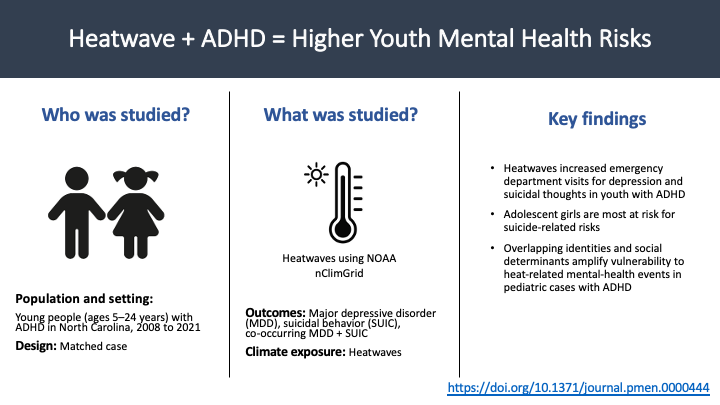
- Heatwaves were associated with increased emergency department visits for major depression and suicidal ideation among youth diagnosed with attention-deficit/hyperactivity disorder (ADHD).
- Youth with ADHD experienced higher sensitivity to extreme heat compared to peers without ADHD, underscoring the risks of heat as a significant environmental stressor for this population.
- Effects persisted across demographic groups and were strongest during multiday, high-intensity heat events, suggesting that prolonged exposure may amplify mental health crises.
About the Study
Using North Carolina emergency department data from 2008–2021, we examined more than a decade of visits among youth ages 5–24. We linked these records with detailed climate data to evaluate how varying heatwave definitions and intensities shaped mental health–related emergency visits among patients with ADHD. The analysis reveals a clear and consistent relationship between extreme heat and acute mental health deterioration in this vulnerable group.
Why This Matters
Although ADHD is one of the most common neurodevelopmental conditions in youth, little is known about how it intersects with climate stressors. As extreme heat events become more frequent and severe, these findings highlight the urgent need to integrate climate-related risk into pediatric and adolescent mental health care, school health planning, and heat preparedness strategies. This study doesn’t say that heat causes depression or suicidal thoughts. But it does highlight an increasingly apparent reality: environmental stress and mental health are deeply connected, and some young people experience this stress more acutely than others.
Read the Article
The full open-access paper is available here: https://doi.org/10.1371/journal.pmen.0000444
For Inquiries
For media or partnership requests, please reach out to the research team:
Jennifer D. Runkle, Charlie Reed, Karla Weidner, Julia Rothschild, Tara Chandrasekhar, and Margaret M. Sugg.